Lebanese Cuisine
Lebanese cuisine is the distilled essence of the Levantine culinary tradition, with roots reaching back to Phoenician civilisation. For millennia, Lebanon stood at the crossroads of trade routes connecting the Mediterranean, Persia, and the Arabian Peninsula — each culture left a mark on the local table. Today, Lebanese cooking is regarded as one of the most refined Arab culinary traditions in the world, recognised globally for its balance of freshness, acidity, and depth of flavour.
The Lebanese table is built on simple ingredients combined with real care. Olive oil is not a condiment but a foundation. Tahini, chickpeas, bulgur, flat-leaf parsley, mint, and fresh lemon juice form the core palette. Pomegranate molasses and sumac deliver tartness; za'atar — a blend of thyme, sumac, and sesame — is a household staple. The defining techniques are charcoal grilling, deep marinating, and the preparation of meze: a constellation of cold and warm small dishes served simultaneously, which is less a starter course than an entire philosophy of eating.
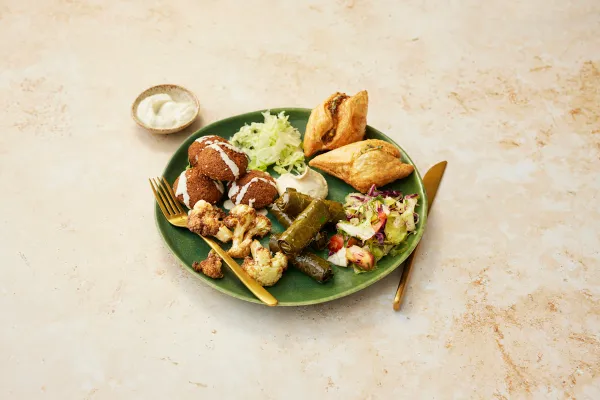
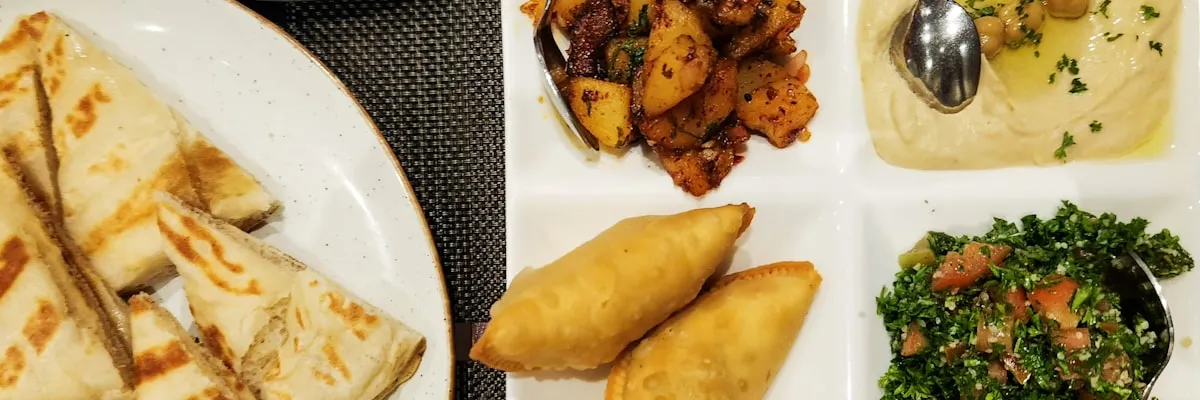
The canon of Lebanese dishes includes hummus in dozens of variations; falafel made from chickpeas or broad beans with fresh herbs; tabbouleh — a parsley and tomato salad with bulgur and lemon, where parsley leads and grain follows; and fattoush with crisp pita and sumac. Shawarma in its Lebanese form — thin-shaved meat with pickles and tahini in flatbread — bears little resemblance to fast-food versions. Kibbeh, finely pounded lamb mixed with bulgur and spices, appears in dozens of forms: fried, baked, and raw. Manoushe, a flatbread topped with za'atar or cheese, is the Lebanese breakfast. Desserts include knafeh — shredded pastry over soft cheese soaked in syrup — and muhallabia, a silky rose-water milk pudding.
The heart of the Lebanese table is meze as a philosophy. A proper meze means 20 to 30 small plates of varying texture, temperature, and flavour, arriving in a slow, conversational rhythm. It is not a prelude to the main event — it is the event, shared over arak, the anise spirit that turns milky white when mixed with water. Pine nuts toasted in butter crown almost every hot dish. Generosity at the table is not a performance but an expression of respect.
In Tbilisi, Lebanese cuisine has found a sympathetic audience: Georgia's own tradition of a laden table, aromatic fresh herbs, and tart walnut-based sauces turns out to be a natural neighbour of the Levantine feast.