Russian Cuisine
Russian cuisine is the food of a continent-sized country, stretching from the Baltic to the Pacific, and the distances show on the plate. Peasant hearth and imperial court shaped two distinct poles of the tradition — one sturdy and thrifty, the other elaborate, absorbing French and European influences through the centuries of the tsars. Short summers and long, punishing winters set the terms: food had to sustain, and provisions had to last. That necessity gave rise to fermentation, salting, dried mushrooms, slow-cooked porridges, and deeply layered broths that remain at the core of Russian cooking today.
The Russian pech — the traditional clay oven — is not merely a tool but a philosophy. Nothing is fried in it; everything is braised or slow-cooked as the heat gently falls away over hours. Meat surrenders its juices, grains swell and soften, and flavours fuse into something greater than the sum of their parts. The essential pantry reads like an ecology of the northern forest and field: rye and buckwheat, sauerkraut, smetana (sour cream), dill and horseradish, foraged mushrooms, and river fish. Fermentation and pickling are not just preservation methods — they are a distinct flavour culture; sourness runs through Russian cooking from the soup pot to the drinking cup. Pies and pirozhki — stuffed with meat, cabbage, egg, mushroom, or fish — were a measure of a cook's worth, made for feast days and ordinary weekdays alike.
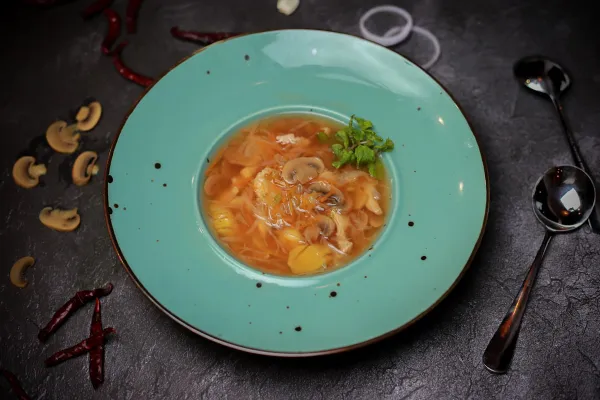
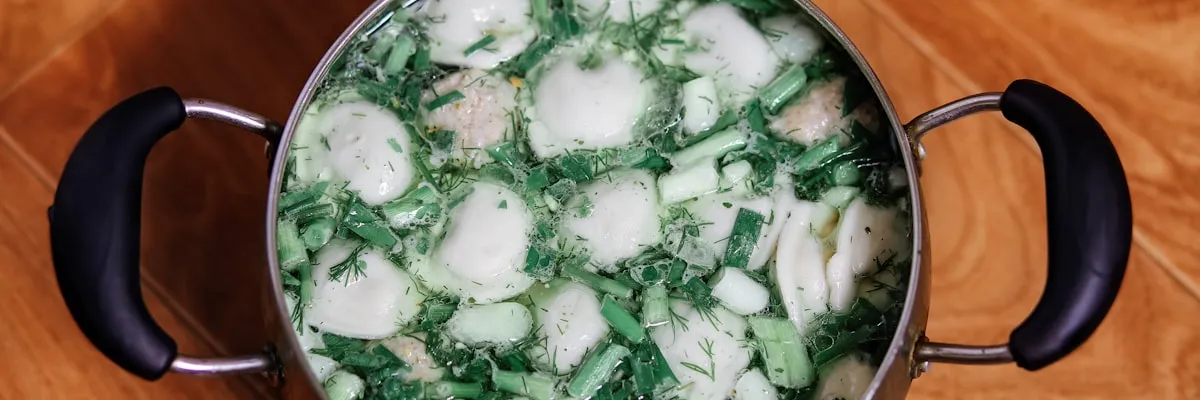
Russian cuisine's signature dishes have travelled far beyond their homeland. Shchi, a sauerkraut and meat soup, has been simmering in Russian kitchens for centuries without going out of fashion. Pelmeni — thin dough wrapped around a mix of pork and beef — originated in the Ural region and became a national staple, the Russian equivalent of a dumpling eaten across a dozen cultures. Blini, thin yeast or kefir pancakes served with caviar, sour cream, or jam, are both the ritual food of Maslenitsa and a weekday breakfast. Beef stroganoff — thin strips of beef in a sour cream sauce — was invented in nineteenth-century St Petersburg and quietly colonised restaurant menus across the world. Ukha is clear fish broth, austere and precise, nothing but fish and root vegetables. Solyanka is the opposite: dense, sour, and loaded with cured meats, pickled cucumbers, and olives. Kulebyaka, a layered pastry filled with multiple fillings arranged in sections, demands real craftsmanship from the baker.
The Russian table has its own rituals. The samovar shaped a particular culture of tea-drinking — long, unhurried, with bagels, jam, and conversation that had nowhere urgent to go. The tradition of cold zakuski — cured meats, pickles, fish, and caviar arranged as a spread before the main meal — developed as both a companion to vodka and a demonstration of hospitality. Maslenitsa turned blini into a symbol of the returning sun; Christmas called for kutya and vzvar; Easter meant kulitch and paskha. And the dacha kitchen deserves a chapter of its own: cucumbers pulled straight from the garden bed, shashlik over glowing coals, jars of black currant jam — the ways a city person stays connected to the land.
In Georgia, Russian cuisine has long ceased to feel foreign. A Russian-speaking diaspora, deep historical ties, and decades of shared Soviet everyday life have made pelmeni, borscht, and blini a natural part of Tbilisi's urban landscape. Russian and Georgian table traditions resonate with each other: in both, the meal is the right setting for anything worth saying, and hospitality is measured not by the number of dishes but by the warmth with which they are offered.