Turkish Cuisine
Turkish cuisine stands alongside French and Chinese as one of the three most influential culinary traditions in the world. The reason lies in history: for six centuries, the Ottoman Empire brought together the cooking of Greeks, Persians, Arabs, Armenians, and Balkan peoples under one roof. Palace chefs at Istanbul's Topkapı competed for the sultan's favour, turning the kitchen into a form of statecraft. The result was a flavour system where lamb meets yogurt, aubergine meets tahini, and spices work not to mask ingredients but to reveal them.
A few building blocks define Turkish cooking. Lamb and beef are the primary proteins, shaped onto skewers or slow-cooked until the fat dissolves into the sauce. Bulgur — cracked wheat, dried in the sun — has fed Anatolia for millennia and still anchors pilafs, salads, and stuffed vegetables. Yogurt serves as sauce, marinade, and side dish simultaneously. Among spices, sumac adds a tart lemony finish; isot (Urfa pepper) brings deep, smoky warmth without sharp heat; and dried mint lifts soups and dips alike. Three techniques give the cuisine its character: open-flame grilling over charcoal, the radiant heat of a tandır oven, and the long, slow braise in a covered pot.
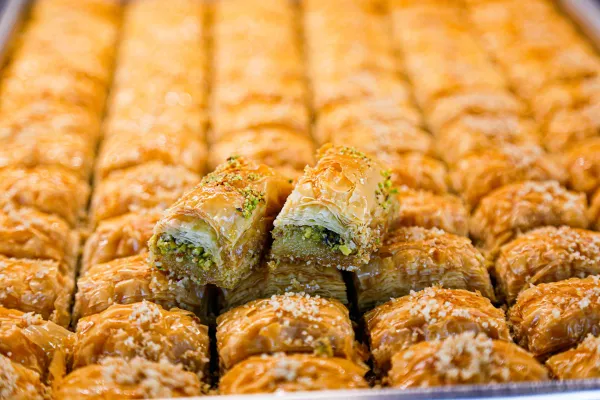
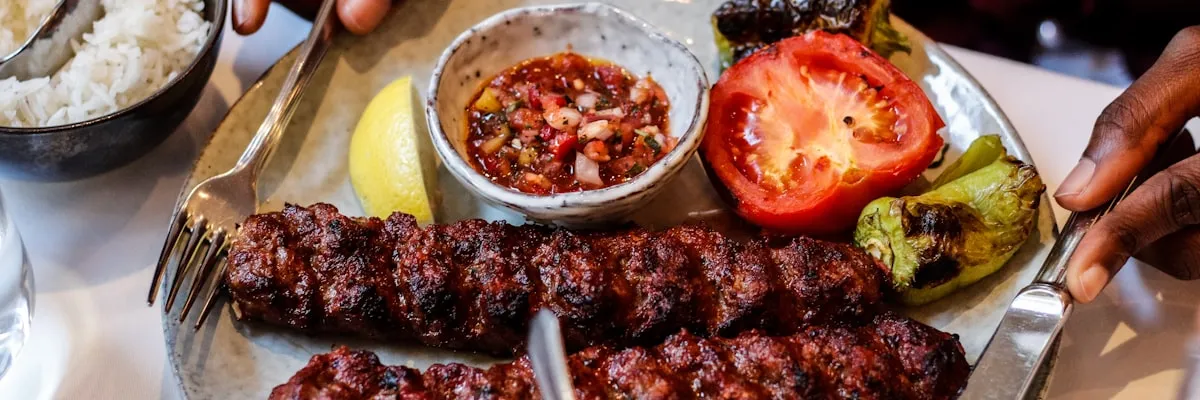
The canonical dishes of Turkish cuisine are recognised worldwide, though their real depth is easy to underestimate. Adana kebab is hand-minced lamb packed with isot and tail fat, pressed flat onto a wide skewer and grilled until charred at the edges. İskender kebab layers doner meat over torn pide, drenched in tomato sauce and brown butter, with cold yogurt alongside. Lahmacun — a paper-thin disc of dough topped with spiced minced meat and herbs — is rolled up, squeezed with lemon, and eaten out of hand. Baklava is a study in patience: dozens of phyllo layers, a filling of pistachios or walnuts, and a syrup scented with rose water. Before the main course comes meze — hummus, baba ghanoush, dolma, haydari, ezme — a spread of small plates that can expand indefinitely and pairs naturally with rakı.
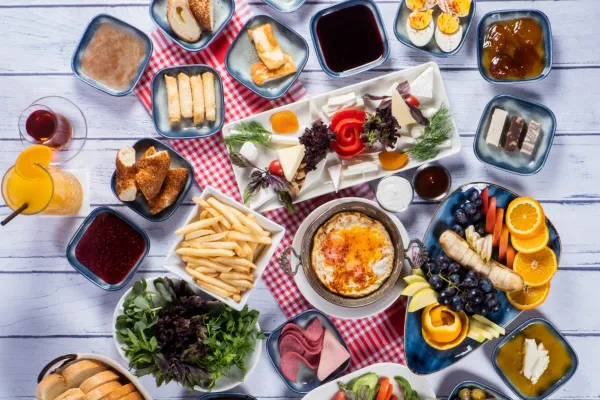
Turkish food culture is built around the ritual of the table. Kahvaltı — the weekend breakfast — is not a meal but an event: olives, white cheese, honey with clotted cream, eggs scrambled in tomato with menemen, fresh bread, and tea served in tulip-shaped glasses that are refilled without asking. The tea culture in Turkey rivals the coffee culture in depth; Turkish coffee, brewed in a copper cezve over hot sand, is something else entirely — slow, almost contemplative.
Georgia and Turkey share more than a border. Adjara, which spent several centuries within the Ottoman Empire, carries traces of that history in its local cooking: specific pastry techniques, nuts worked into sweets, a generous hand with spice. Batumi, with its Black Sea temperament, is one of the places where two culinary traditions meet without friction — and where a plate of lahmacun or a glass of strong tea feels entirely at home.